

The main types and what they’re actually for
Most commercial kitchens need more than one type of refrigeration. The categories below describe what each unit does and where it fits in a working kitchen.
Reach-in refrigerators are the upright units you see in nearly every commercial prep area. They come in one, two, and three-door configurations, from roughly 23 cubic feet for a single door up to 80-plus cubic feet for a three-door model. For most mid-size restaurants, a two-door reach-in handles daily mise en place without problems. The main variables are compressor location (top or bottom), door style (solid or glass), and whether you need a full door or half-door setup.
Undercounter refrigerators fit beneath prep tables and work surfaces. They’re useful in bar setups, pizza stations, and anywhere you need cold storage at arm’s reach without giving up wall space. Capacity is limited, typically 5 to 15 cubic feet, so these work as supplementary units rather than primary storage.
Refrigerated prep tables sit at the intersection of refrigeration and work surface. Sandwich, salad, and pizza prep tables keep ingredients cold in top-mounted railings while you work. If your kitchen runs high volume during lunch, these pay for themselves in reduced reach time.
Walk-in coolers are a different category entirely. They’re for bulk storage, not line access. Most restaurants don’t need a walk-in on day one, but as volume grows, the math usually shifts. Walk-ins also allow proper FIFO stock rotation because you can physically move around inside.
Merchandising refrigerators are glass-door units designed for customer-facing display. They keep beverages, prepared foods, or grab-and-go items at temperature while making them visible. These units prioritize lighting and aesthetics as much as cold storage performance.
Specs that matter before you buy
Marketing language from equipment manufacturers tends to blur together. Here’s what to look at in the actual spec sheet.
| Spec | What to look for | Why it matters |
|---|---|---|
| NSF/ANSI 7 certification | Must have | Required for commercial use in Canada; ensures sanitary design |
| Temperature range | Holds 0-4 C (32-40 F) | Food safety compliance with Health Canada guidelines |
| Energy Star certification | Preferred | Uses up to 20% less electricity; lowers operating costs |
| Compressor location | Top-mount preferred | Stays cooler in warm kitchens; easier service access |
| Refrigerant type | R-290 or R-134a | R-290 has lower environmental impact; increasingly required |
| Pull-down time | Under 4 hours to reach 2 C | Indicates unit can recover after repeated door openings |
| Door gaskets | Replaceable magnetic | Worn gaskets cause temperature drift; replaceable ones save cost |
| Interior material | Stainless steel liner | Easier to clean; resists corrosion longer than aluminium |
One thing many buyers miss: the “rated capacity” in cubic feet is the total interior volume, not usable shelf space. A unit listed at 49 cubic feet might have effective storage of 35-38 cubic feet once you account for shelving, door hinges, and evaporator placement. Ask your supplier for shelf count and actual tray dimensions.

Top-mount vs bottom-mount compressors: which to choose
This is one of those decisions where context decides everything. There’s no universally better option, but there is a better option for your specific situation.
Top-mounted compressors sit above the cabinet. They pull air from the top of the kitchen, which is typically cooler than floor level. That means the compressor runs in a more comfortable temperature range, which generally translates to longer compressor life. Access for service is straightforward without getting on the floor. The tradeoff: they add height to the unit, which matters if your kitchen has low ceilings or overhead racks.
Bottom-mounted compressors sit below the cabinet. They’re easier to reach for operators doing daily checks, and the lower profile suits some kitchen layouts better. The downside is that floor-level air in a busy kitchen is hotter and greasier. Bottom mounts require more frequent coil cleaning, especially in kitchens running fryers or grills nearby. If a bottom-mount coil gets clogged, the compressor works harder and fails earlier.
In most Canadian restaurant kitchens, top-mount units are the safer choice. The service history tends to be better, and the energy consumption is more predictable. Bottom-mount units make sense in counter-depth setups where height is constrained, or in front-of-house applications where noise and access patterns differ from a back-of-house prep line.

Brands worth knowing in Canada
The commercial refrigeration market has a lot of options. These are brands with strong track records for Canadian buyers and reasonably good parts availability.
True Refrigeration is the most commonly recommended brand in the industry. Their reach-in units hold temperature well in variable kitchen conditions, and the company has a long warranty programme. Parts are stocked widely across Canada.
Beverage-Air offers solid mid-range options at lower price points than True. The quality is dependable for kitchens running moderate volume. Their glass-door merchandisers are popular in convenience stores and cafes.
Atosa has grown significantly in the Canadian market as a value-focused option. The price is attractive and the build quality is acceptable for smaller operations. The main concern with any budget brand is parts availability in smaller markets, so check before buying.
Turbo Air makes strong refrigerated prep tables and sandwich units. Their M3 series reach-ins are popular in Toronto and Vancouver restaurant supply circles for the combination of price and reliability.
Watch: Commercial Kitchen Inspection: Types of Refrigeration (CCPIA, YouTube)
FAQ: commercial refrigerators for Canadian restaurants
What temperature should a commercial refrigerator run in Canada?
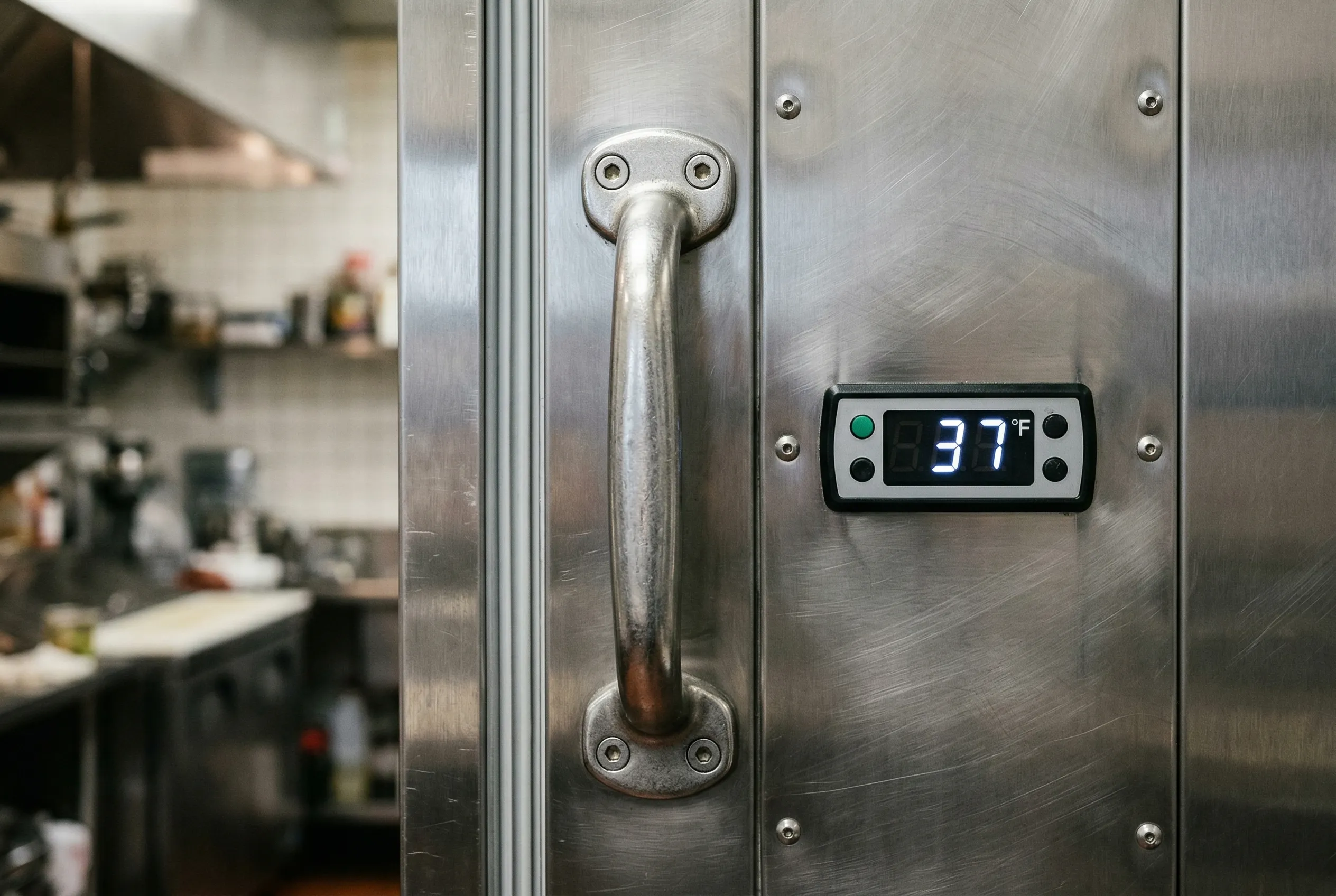
Health Canada requires refrigerators to hold food at 4 C (40 F) or below. In practice, most operators set their units to run at 1-3 C (34-37 F) to give a buffer above the 4 C limit. The food safety danger zone in Canada is 4 C to 60 C, where bacteria multiply rapidly.
Is NSF certification mandatory for commercial refrigerators in Canada?
NSF/ANSI 7 certification is required by most provincial health authorities for any refrigeration unit used in a commercial food operation. Some municipalities also reference NSF 3 for specific applications. Always confirm with your local public health inspector before purchasing.
How long should a commercial refrigerator last?
A well-maintained commercial refrigerator from a reputable manufacturer typically lasts 10-15 years. The compressor is usually the limiting component. Brands offering 5-year compressor warranties give you a reasonable indication of expected longevity. Regular coil cleaning and gasket replacement extend lifespan considerably.
Reach-in or undercounter: which do I need for my prep line?
If your prep cooks need frequent access to a variety of ingredients during service, a reach-in is almost always better. Undercounters work well for a single station that uses a small, defined set of ingredients. For sandwich or salad lines, a refrigerated prep table with a cutting board top and ingredient rail is often the most efficient option of all.
Can I use a residential refrigerator in my commercial kitchen?
No. Residential refrigerators are not rated for the temperature recovery demands of a commercial kitchen, and they won’t pass a health department inspection. They lack NSF certification and are not built for repeated door openings during service. Using one also voids the warranty and creates liability.
Choosing the right refrigeration comes down to being honest about your actual volume. Overbuy and you’re paying to refrigerate air. Underbuy and you’re constantly fighting temperature recovery or running out of space during prep. If you’re not sure which configuration fits your kitchen, the team at Canada Food Equipment can walk you through the options based on your menu, cover count, and floor plan. They carry True, Atosa, Turbo Air, and more at their Etobicoke location.