
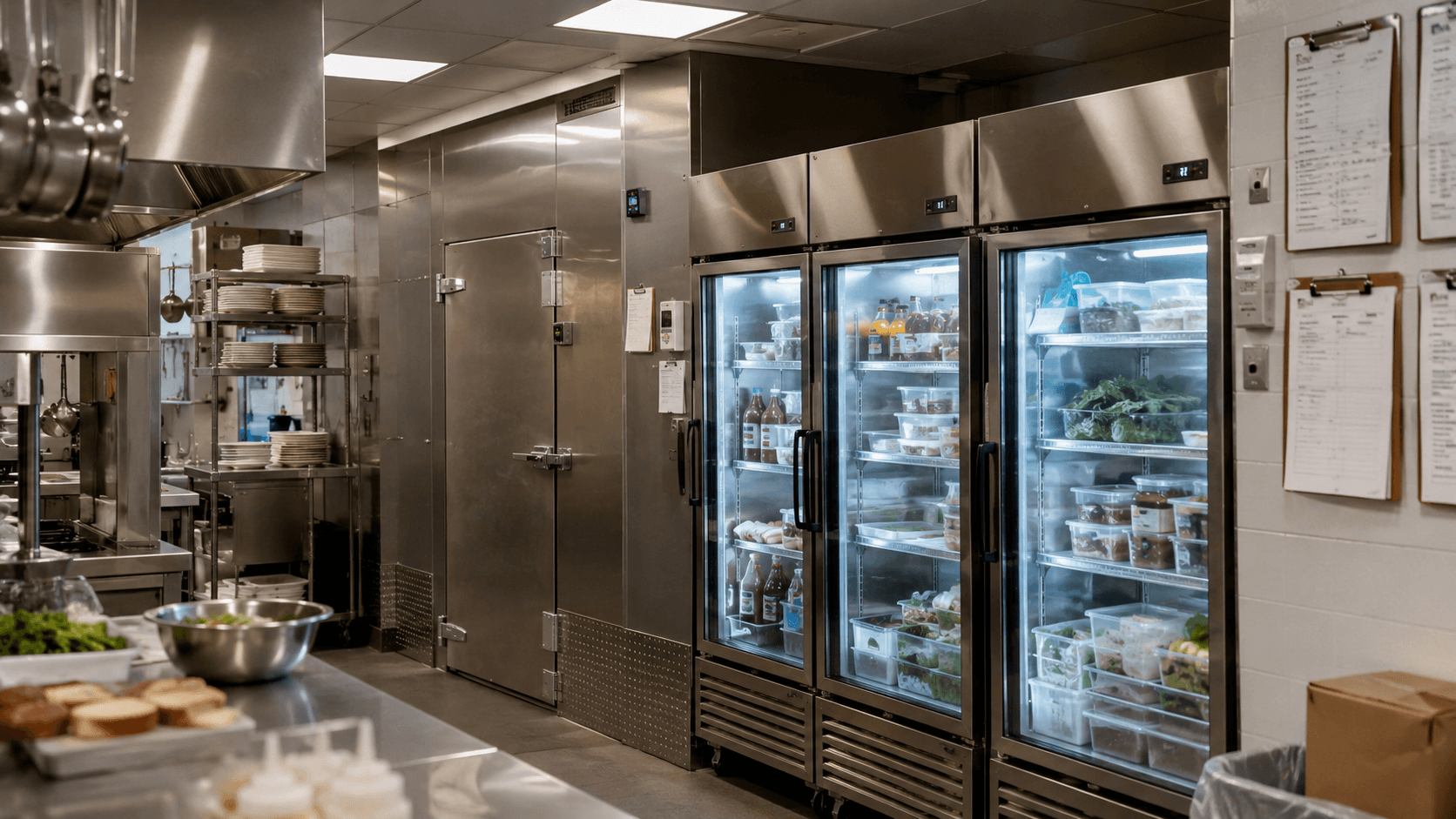
Commercial refrigeration is the single biggest energy cost in most restaurant and food service operations, accounting for 30-45% of total electricity consumption. Unlike lighting or HVAC, refrigeration runs 24 hours a day, 365 days a year, never stopping between services or overnight. A walk-in cooler running just 10% less efficiently than it should costs a typical Canadian restaurant $400-$1,200 extra per year.
The good news? Most commercial refrigeration energy savings don’t require expensive equipment replacement. Many of the most effective interventions are operational changes or low-cost maintenance tasks that can be implemented by your staff immediately. Here are the most practical ways to reduce your commercial refrigeration energy costs using the equipment you already have.
The True Cost of Inefficiency
A typical full-service restaurant might be running $5,000-$10,000 per year in refrigeration electricity costs alone. Reducing that by even 20% through better maintenance saves $1,000-$2,000 per year. For a restaurant operating on 5-10% net margins, $2,000 in energy savings is equivalent to generating $20,000-$40,000 in additional revenue.
Beyond the hydro bill, there are serious maintenance benefits. Inefficient units run their compressors harder and longer, generating more heat and accelerating wear. Keeping a unit running efficiently extends the interval between major repairs, saving you from a $1,500-$3,500 emergency compressor replacement.
Tips 1-2: Gaskets, Seals, and Door Discipline
Tip 1: Perform the Dollar-Bill Test. Door gaskets are the rubber or vinyl seals around the perimeter of refrigerator doors. When they harden or crack, cold air escapes continuously. Perform the dollar-bill test monthly: close the door on a piece of paper and try to pull it out. If the paper slides out easily without resistance, the gasket is failing. Replacement gaskets cost $40-$150 and typically pay for themselves in energy savings within 3-6 months.
Tip 2: Minimize Door Open Time. This is purely operational but makes a massive difference. Equip staff with protocols: install PVC strip curtains on walk-in doors (these plastic barriers reduce cold air loss by up to 40% in high-traffic coolers), enforce a policy about closing doors promptly, and organize interior shelving so staff aren’t leaving the door wide open while searching for ingredients.
Tips 3-4: Condenser Coils and Airflow Management
Tip 3: Clean Condenser Coils Quarterly. When condenser coils are coated with kitchen grease and dust, their ability to transfer heat is severely reduced. The compressor must run longer and at higher pressure. Cleaning coils is straightforward: use a stiff refrigeration coil brush and a vacuum. Moving from annual to quarterly cleaning can reduce energy consumption by 10-20% on neglected units.
Tip 4: Clear the Airflow. Condenser coils need clear airflow on both the intake and exhaust sides. In many commercial kitchens, boxes are stacked against refrigeration units, suffocating the compressor. Ensure there’s at least 6 inches of clearance around condenser coils and that exhaust air from one unit isn’t blowing directly into another.
Watch: Restaurant Energy Efficiency Tips – Refrigeration
Tips 5-6: Temperature Settings and Thermostat Calibration
Tip 5: Do Not Set It Colder Than Necessary. There’s a misconception that running refrigeration colder is always better. Running a walk-in cooler at 32°F instead of the optimal 36-38°F increases energy consumption by roughly 8-12% without meaningful food safety benefit. Verify your equipment is set strictly to the minimum safe temperature recommended by Health Canada.
Tip 6: Calibrate Thermostats. Commercial refrigeration thermostats drift over time. A unit that reads 36°F at the control panel may actually be holding 28°F (wasting energy). Use a calibrated digital thermometer to verify actual temperatures against the thermostat reading. If they differ, have a technician recalibrate it.
When It Is Time to Upgrade (and Get Rebates)
If your refrigeration units are more than 10-15 years old, simple maintenance might no longer be enough. Older compressors and shaded-pole fan motors draw significantly more electricity than modern, Energy Star certified models equipped with EC (electronically commutated) motors.
Looking to replace an old, inefficient unit?
The wrong purchase will cost you in high energy bills for the next decade. Before you buy, read our comprehensive Commercial Refrigerator Buying Guide for Canadian Restaurants to learn which configurations, brands, and compressor locations (Top vs. Bottom) save the most money over time.
The good news is that Canadian utility companies (like Hydro Quebec, Ontario Hydro, and BC Hydro) offer significant rebates for upgrading to Energy Star commercial refrigeration. The combination of utility rebates and the ongoing monthly hydro savings means a new, efficient unit often pays for itself much faster than operators expect.
Need Energy-Efficient Commercial Refrigeration?
Canada Food Equipment offers new and used commercial restaurant equipment across Canada, including top brands like True and Atosa. Get in touch for expert advice and competitive pricing.
Browse Our Inventory