
Picture a commercial butcher counter on a busy Saturday morning. The cooler is stocked, the scales are calibrated, and the team arrives to a knife roll built around just one all-purpose blade. By noon, that single knife has been pressed into portioning primals, trimming fat, and separating meat from bone, leaving the edge dulled and inefficient. The solution is rarely just a sharper edge; it is selecting the correct blade for the exact task. Understanding the different types of butcher knives and their uses in a working shop or commercial kitchen is essential for efficiency, safety, and precise cuts, whether you are exploring Canada Food Equipment’s range of commercial knives or curating a professional set.
The Core Lineup: Six Blades Worth Knowing
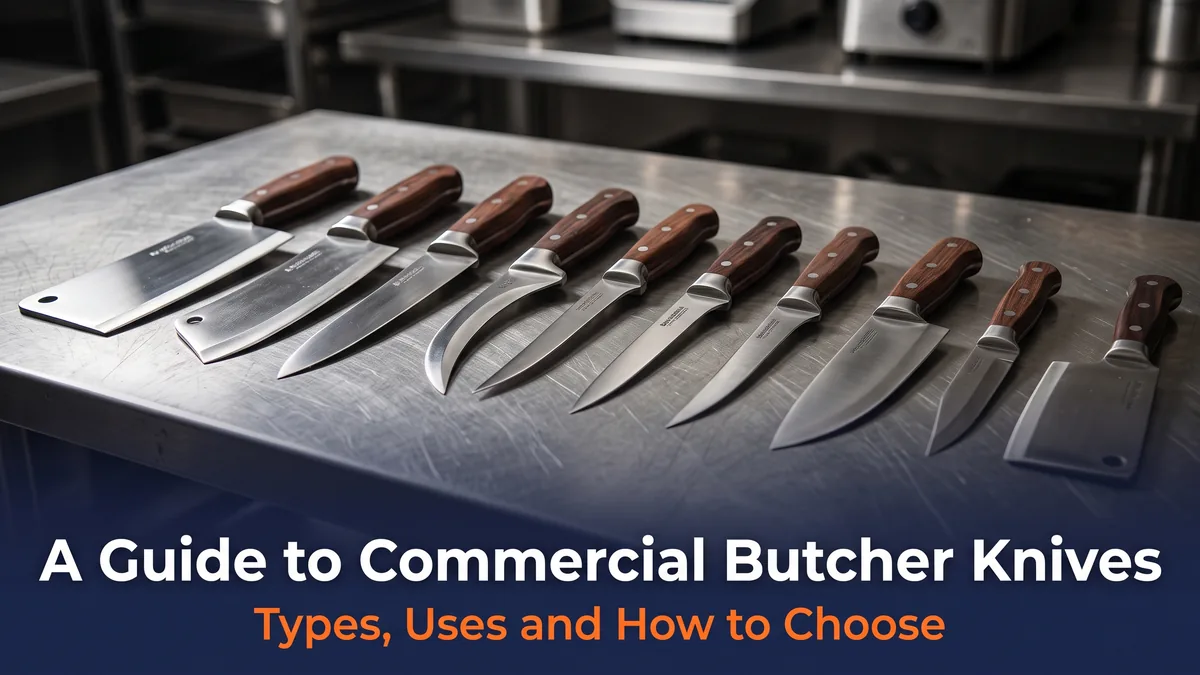
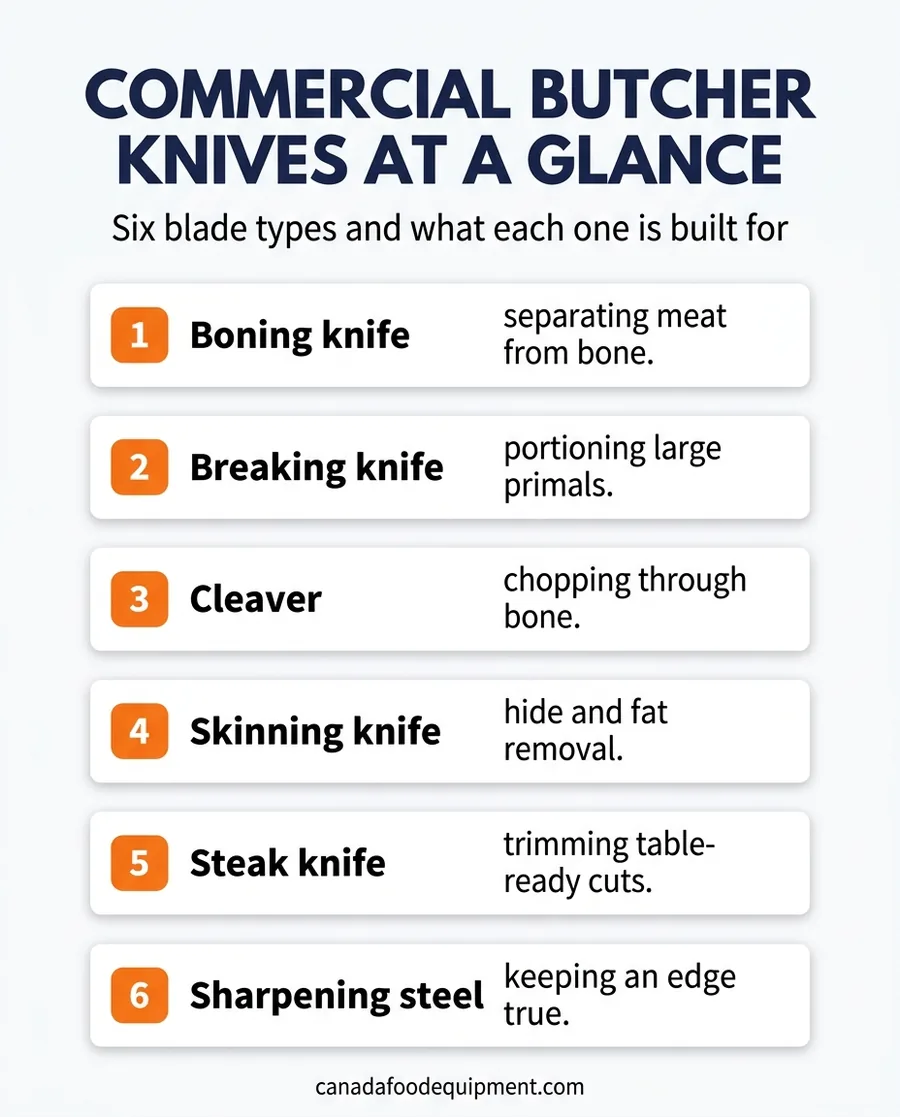
A commercial knife roll does not need to be overly large, but it must provide variety. Each blade below is engineered for a primary function, and adhering to that intended purpose preserves edge life throughout full demanding shifts.
- Boning knife: A narrow, slightly flexible blade engineered to navigate close to bones and joints without wasting yield.
- Breaking knife: A longer, curved blade designed for initial cuts on large primals, slicing through major muscle groups with long, steady strokes.
- Cleaver: A heavy, thick-spined blade intended for splitting bone and dense cartilage rather than slicing soft tissue.
- Skinning knife: A short blade featuring an upward curve, contoured to separate hides and skin from muscle and fat cleanly.
- Steak or trim knife: A short, nimble blade used for finishing table-ready portions and refining presentation cuts.
- Sharpening steel: A maintenance tool used to realign blade edges between full professional sharpenings.
Did you know?
A full-tang construction (where the blade steel extends continuously through the entire length of the handle) is a primary marker of durability for heavy commercial kitchen work, offering superior balance and leverage under continuous force.
Matching Types of Butcher Knives and Their Uses to the Cut
Using a breaking knife for delicate boning work, or a trim knife for breaking down whole sides, reduces shop productivity and accelerates blade wear. Below is an overview outlining the primary commercial types of butcher knives and their uses across common cutting tasks.
| Knife Type | Primary Task | Typical Blade Length |
|---|---|---|
| Boning Knife | Separating meat from bone around joints and cartilage | 5 to 6 inches |
| Breaking Knife | Portioning large primals into subprimal cuts | 8 to 10 inches (curved) |
| Cleaver | Chopping through dense bone and joint structures | 6 to 8 inches (heavy spine) |
| Skinning Knife | Removing hide and excess fat layers | 5 to 6 inches (upward curve) |
| Steak or Trim Knife | Trimming silver skin and finishing retail portions | 4 to 5 inches |
Shops handling pre-portioned boxed beef typically require only a boning knife, a trim knife, and a honing steel. Kitchens breaking down whole carcasses or primals require breaking knives and heavy cleavers in active rotation. Match your inventory purchase to the work actual production demands.
Pro tip
A sharp knife requires less physical downward pressure, making it inherently safer than a dull blade that can slip off dense tissue. Pair high-volume breaking and boning tasks with proper cut-resistant safety gloves. Refer to safety standards provided by the Canadian Centre for Occupational Health and Safety when equipping your cutting staff.
Blade Steel and Edge Retention
Commercial butcher blades are primarily manufactured using high-carbon steel or stainless steel alloys, each presenting distinct operational trade-offs:
- High-Carbon Steel: Takes an exceptionally fine edge and is simple to touch up on a steel, though it requires diligent cleaning and drying to prevent staining or corrosion.
- Stainless Steel Alloys: Offers superior resistance to rust and harsh sanitation chemicals, making them ideal for wet processing areas and dishwasher washing, though they may require more frequent sharpening sessions to maintain peak edge sharpness.
Handle, Tang, and Grip
Aesthetics and handle construction directly affect butcher productivity and hand fatigue during extended shifts. Polymer and composite handles are standard across food processing environments due to their non-porous nature, chemical resistance, and ease of sanitization. While traditional wood handles offer comfortable grip ergonomics, they require specialized maintenance to prevent moisture absorption and bacterial growth.
Tang construction is equally critical. Full-tang knives distribute weight evenly and withstand heavy leverage during breaking or chopping cuts. Partial-tang blades serve lighter trimming roles well but may fail under severe leverage on heavy primals.

Honing Versus Sharpening
Maintaining commercial knives involves two separate procedures: honing and sharpening.
- Honing: Performed repeatedly using a sharpening steel, honing realigns microscopic teeth along the blade edge without removing metal. This process takes seconds and restores slicing efficiency throughout a shift.
- Sharpening: Uses whetstones, grinding wheels, or professional sharpening services to physically shave away metal to form a fresh edge angle once honing no longer restores edge sharpness.
Building a Starter Set
For a newly established butcher counter or kitchen line, a practical foundational set includes one boning knife, one breaking knife, one heavy cleaver, and a honing steel. Additional specialized blades can be acquired as production demands grow. Understanding key types of butcher knives and their uses helps prevent purchasing unnecessary cutlery that remains unused in storage.
Visit Canada Food Equipment’s Toronto showroom to physically evaluate handle balance across our boning knife inventory and full commercial kitchen knife collection.
Download the Free Quick Guide
Save this commercial blade guide as a PDF reference for your kitchen staff.
Canada Food Equipment’s 150,000-square-foot Toronto showroom offers a complete selection of commercial cutlery, food processing gear, and heavy butcher machinery. We supply food service businesses nationwide through our dedicated national service channels.
Frequently Asked Questions
What is the difference between a boning knife and a breaking knife?
A boning knife features a short, narrow blade crafted to maneuver precisely around bones, joints, and connective cartilage. A breaking knife features a longer, curved blade designed to execute sweeping cuts through primary muscle groups when breaking whole primals into smaller portions.
Do I need a cleaver if I already have a breaking knife?
Yes, if you regularly chop through bone or thick cartilage. Breaking knives are designed exclusively for slicing muscle and soft tissue; using them to strike bone can chip or fracture the cutting edge. Cleavers feature heavy spines built to absorb high-impact bone chopping.
How often should a commercial butcher knife be sharpened?
Commercial blades should be honed daily with a sharpening steel to keep the edge aligned. Full sharpening should occur every few weeks or months depending on bone contact volume, blade steel hardness, and cutting board materials used.
What handle material holds up best in high-sanitation kitchens?
Non-porous polymer, Fibrox, and composite resin handles withstand frequent chemical washing and commercial dishwashers without cracking, splitting, or harboring bacteria.
Understanding the essential types of butcher knives and their uses allows kitchen operators to boost efficiency and optimize yields. Explore our Toronto showroom or browse our complete commercial knife inventory online to select the ideal cutlery for your processing needs.