

Should you buy a gas or an electric commercial fryer? The honest answer is that it depends on three things: where your kitchen gets its energy, how fast you need oil to recover during a rush, and what your local utility charges per unit. Both technologies fry beautifully. The difference shows up in install cost, recovery speed, and your monthly bills. If you are weighing models right now, our range of commercial deep fryers covers both, and this guide walks through how to pick the right one for your menu and your room.
Quick take
Choose gas if you run high-volume frying, already have a gas line, and want the fastest oil recovery for back-to-back baskets. Choose electric if you have limited or no gas service, want simpler installation and more even heat, or are fitting out a smaller or mobile kitchen. Most kitchens can succeed with either; the deciding factors are volume and the utilities you already have.
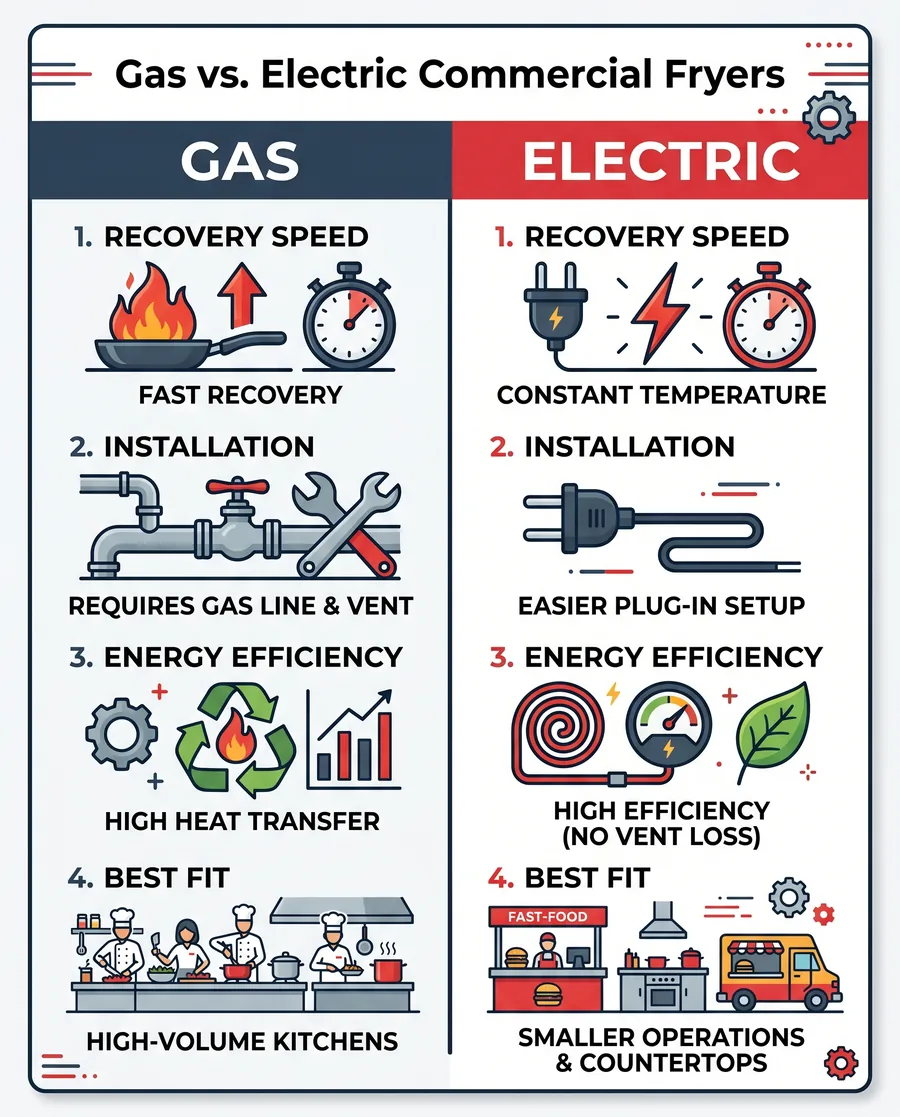
The two options at a glance
A commercial fryer heats a vat of oil to roughly 175 C and holds it there while baskets of cold, wet food keep pulling the temperature down. The job of the burner or element is to put that heat back fast. That is the whole game, and gas and electric go about it differently.
Gas fryers burn natural gas or propane under the oil vat. They heat the oil through the tank walls or through internal tubes, and they tend to deliver a lot of raw power, which means strong recovery during a busy service. Electric fryers use heating elements that sit directly in the oil. Because the element is immersed, electric units transfer heat very efficiently and hold a steady, even temperature, which is part of why so many countertop and lower-volume models are electric.

Gas vs electric: side by side
Here is how the two stack up on the factors that actually affect a working kitchen. Treat this as a starting point for a conversation with your supplier, not a hard rule for every model.
| Factor | Gas fryer | Electric fryer |
|---|---|---|
| Oil recovery speed | Very fast, strong for high volume | Fast and very steady, great for consistency |
| Heat-up from cold | Quick | Often a touch slower to reach temp |
| Energy efficiency at the vat | Lower, more heat escapes | Higher, immersed element heats oil directly |
| Installation | Needs a gas line and proper venting | Needs the right electrical service and outlet |
| Upfront cost (typical) | Often lower per BTU of output | Comparable; countertop models can be cheaper |
| Temperature evenness | Good | Excellent, very stable |
| Best fit | High-volume, gas-equipped kitchens | Smaller, mobile, or all-electric kitchens |
| Cleaning and service | Burners and venting to maintain | Elements often swing up for easy cleaning |
Notice that neither column is all wins. Gas gives you brute recovery power but loses more heat to the room and needs venting. Electric is more efficient at the oil and easier to install, but a high-output gas unit will usually out-recover an electric one of the same size. For more on matching a fryer to your menu, see our guide on choosing the best fryer for your menu.
What each one really costs to run
Pricing and figures note: Any prices, energy figures, or running-cost numbers on this page are general 2026 estimates for commercial equipment in Canada and are meant for planning only. What you actually pay or save depends on the make and model, your menu and volume, local utility rates, install conditions, and the quote your supplier or utility provides. Always confirm current pricing and specifications before you buy.
Operating cost comes down to two things: how efficiently the fryer turns energy into hot oil, and what you pay for that energy. Electric fryers convert a higher share of their input into useful heat at the oil, so they often look very efficient on paper. But in much of Canada, natural gas costs less per unit of energy than electricity, which can flip the math back toward gas in a high-volume kitchen.
The cleanest way to compare is to look for certified models. Both gas and electric fryers can earn an ENERGY STAR rating, which means they meet heavy-load cooking efficiency and idle-energy targets. In Canada, you can cross-check eligible products through Natural Resources Canada. A certified fryer of either fuel type wastes less energy idling between rushes, which is where a surprising amount of a fryer’s lifetime cost actually hides.
Save your money: count the idle hours
Most fryers spend more of the day holding temperature than actively cooking. That idle energy adds up. Before you pick a fuel type, estimate how many hours your fryer sits hot but unused, then favour a model with strong idle-efficiency numbers, whatever the fuel. Pair that with a good lid and a habit of switching to a lower hold temperature during slow periods, and you can trim your fryer energy bill noticeably without changing a single recipe.
People often ask: is gas or electric cheaper overall?
For a high-volume kitchen that already has a gas line, gas is often cheaper to run because natural gas tends to cost less per unit of energy than electricity in most of Canada, and gas units recover fast enough to keep up. For a low to medium volume kitchen, or one without gas service, a modern electric fryer is usually the better total value once you factor in its higher efficiency and simpler install. There is no single winner; the cheaper option is the one matched to your volume and your local utility rates.

Which fryer fits which kitchen
Step back from the spec sheet and look at your operation. The right answer usually becomes obvious once you frame it around volume and utilities.
- High-volume restaurant or quick-service. If fries, wings, and fried items are core to your menu and you already have gas, a floor-standing gas fryer with strong recovery is hard to beat.
- Cafe, bar, or low to medium volume. An electric fryer, often countertop, gives you steady temperature, easy cleaning, and a simple plug-and-go install when frying is a side act, not the headliner.
- Food truck or mobile kitchen. Power and space drive the call. Many trucks run propane for fast recovery off-grid; others go electric when shore power or a generator can handle the load.
- New build or full renovation. If you are running new utilities anyway, decide on fuel before the trades arrive, because adding a gas line or upgrading electrical service later is expensive.
If your kitchen is built around live-flame cooking, it is worth thinking about your whole line at once. The same gas-versus-electric trade-offs show up on your stovetop, which we cover in our piece on gas versus electric commercial ranges.
Edge cases and common mistakes
Please note: This article is for general guidance only and is not a substitute for your equipment manual, your manufacturer, or a licensed professional. Canada Food Equipment is not liable for any damage, injury, or cost resulting from action taken based on this content. Commercial cooking and refrigeration equipment involves gas, high voltage, hot oil, and refrigerant. Anything beyond routine cleaning, especially gas, electrical, or sealed refrigeration work, must be handled by a qualified technician, and you should always follow your local food-safety and health-authority requirements.
- Buying more BTUs or watts than you need. Oversizing wastes energy and money. Match output to your real peak, not your busiest day ever.
- Forgetting the hood and venting. Gas fryers produce combustion byproducts and need proper ventilation. Confirm your hood and make-up air can handle the unit before you buy.
- Ignoring electrical capacity. A big electric fryer can need a dedicated circuit and specific voltage. Have an electrician confirm your panel can carry it.
- Skipping sanitation and food-safety basics. Choose equipment built for commercial cleanability and run it within your food-safety program. The Canadian Food Inspection Agency outlines the food-safety expectations every foodservice operator works under.
- Overlooking maintenance. Whatever you choose, oil management and regular service decide how long it lasts. Our complete deep fryer maintenance guide walks through the routine.
Sources and further reading
- ENERGY STAR – Commercial fryers efficiency program.
- Natural Resources Canada – ENERGY STAR Canada certified products.
- Canadian Food Inspection Agency – Food safety for industry.
- Canada Food Equipment, in-house commercial fryer product knowledge and 2026 supplier observations.
Frequently asked questions
Download the free quick guide
Take our printable gas versus electric comparison and buying checklist to your next equipment decision.
Not sure which fryer your kitchen needs?
The verdict: gas wins on recovery for high-volume, gas-equipped kitchens, while electric wins on efficiency and easy installation for smaller or all-electric setups. Match the fuel to your volume and your utilities and you will not go wrong. Browse our selection of commercial deep fryers, stock up on fryer baskets and filters, or contact our team and we will help you spec the right unit.