
The three types: undercounter, door-type, and conveyor
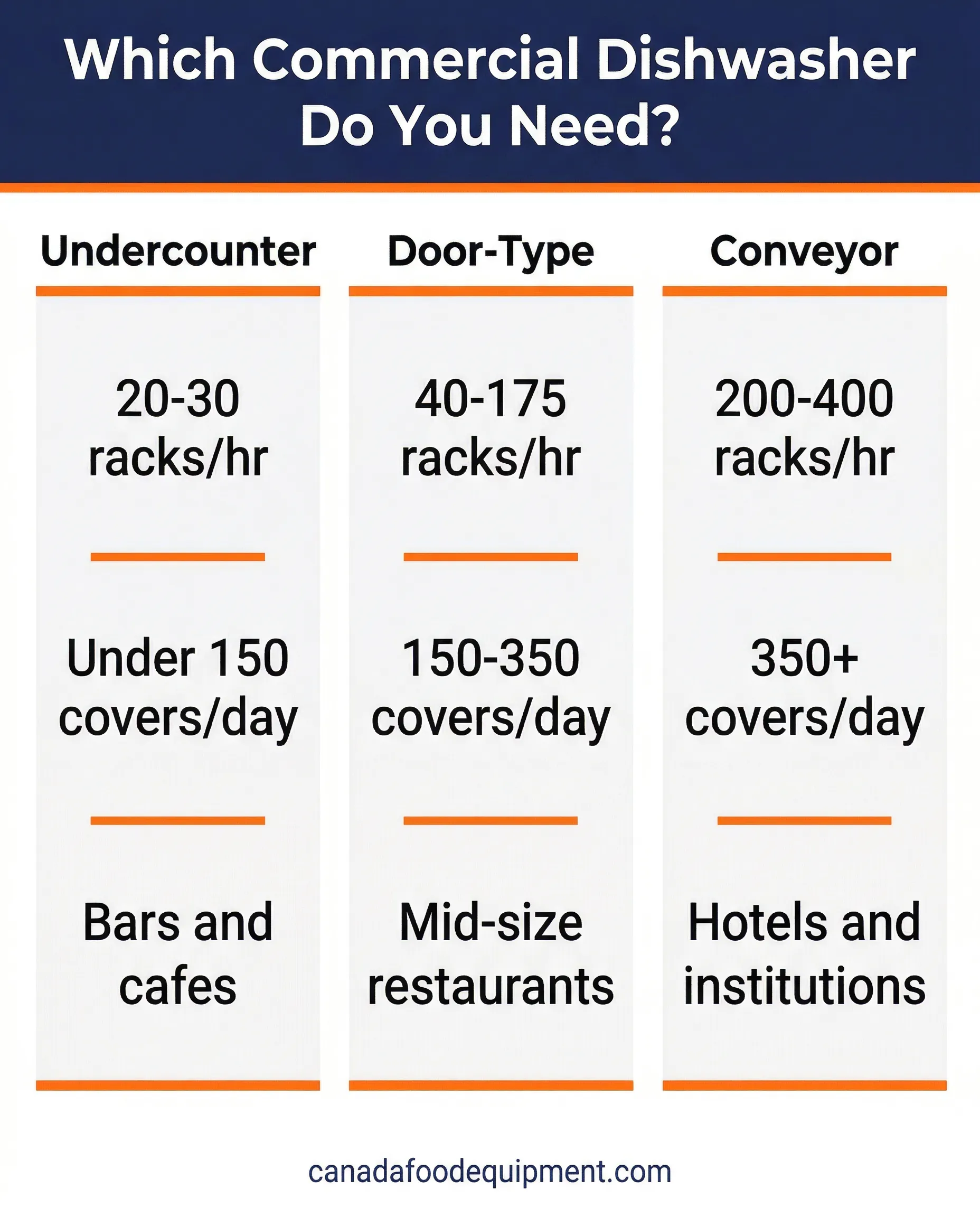
Each type fits a specific output range. The simplest way to choose is to know your daily cover count at peak, then size for 20% above that.
Undercounter dishwashers are compact units that sit below a counter surface and operate similarly to a residential dishwasher, but built for commercial use. They process one rack at a time, typically doing 20-30 racks per hour. A rack holds roughly 20-25 plates, so you’re looking at 400-750 plates per hour under ideal conditions. In practice, with loading and unloading time, figure around 150 covers per day as a realistic ceiling before you’re creating a bottleneck. These units are the right choice for bars, cafes, small diners, and hotel bars that need fast turnaround on glassware and light dishware.
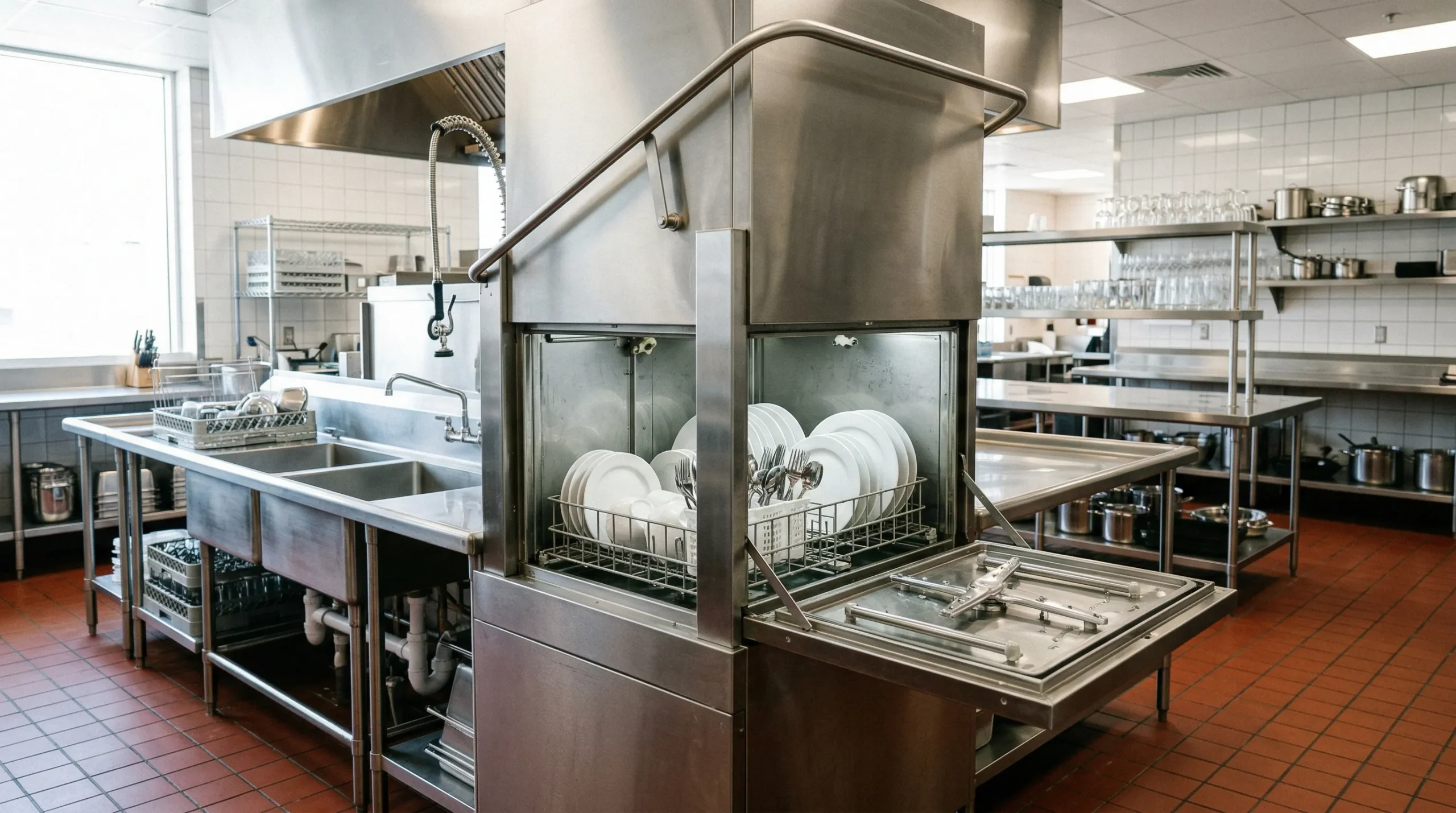
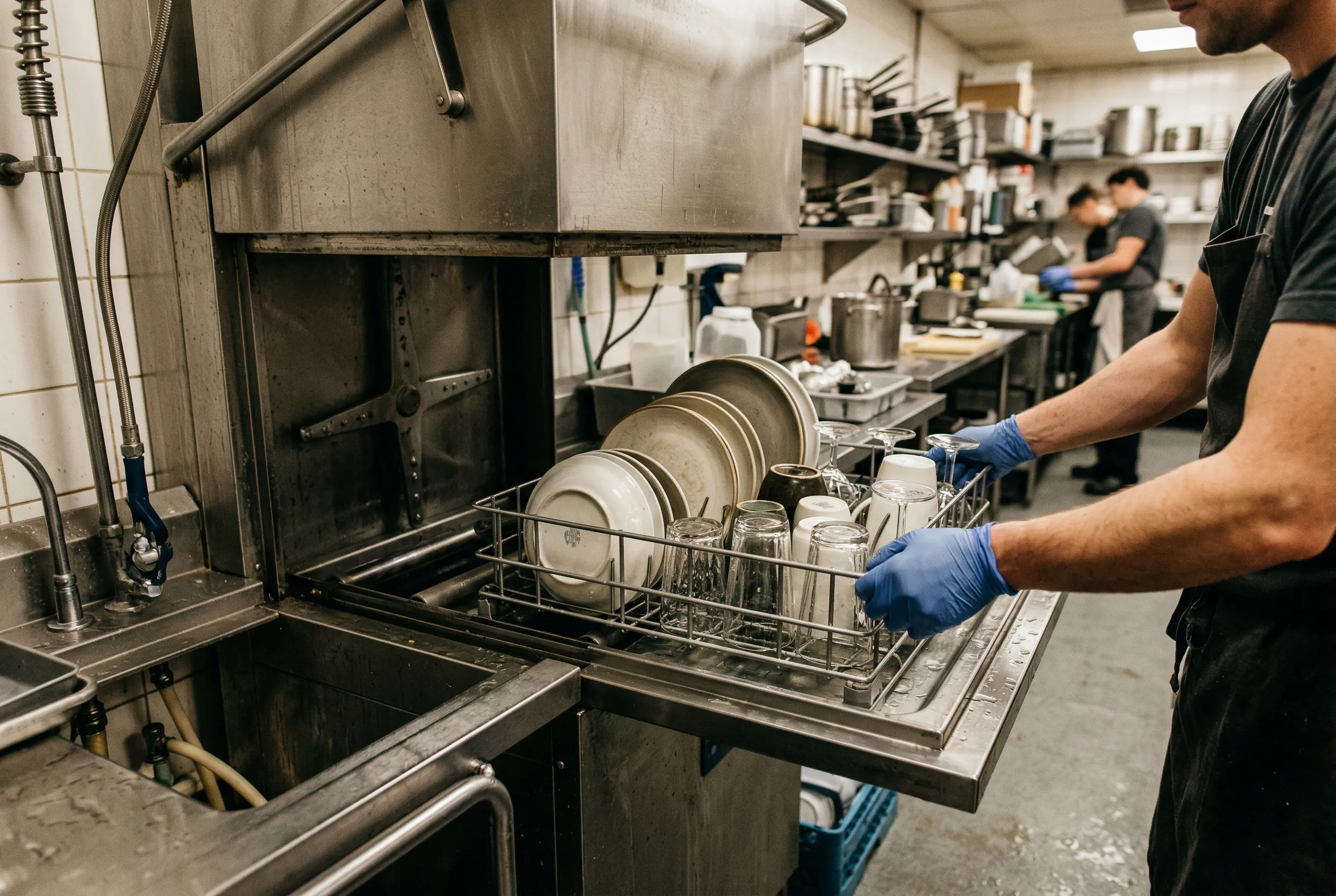
Door-type dishwashers (also called pass-through or hood-type) lift from the top rather than swinging out like a standard door. A loaded rack slides in, the door drops, the cycle runs, and the rack comes out the other side. This design allows one person to load and unload continuously, which is why throughput is substantially higher: 40-175 racks per hour depending on the model and cycle time. This range covers most mid-size full-service restaurants operating up to 350 covers per day. They’re the most common choice for restaurants doing serious volume.
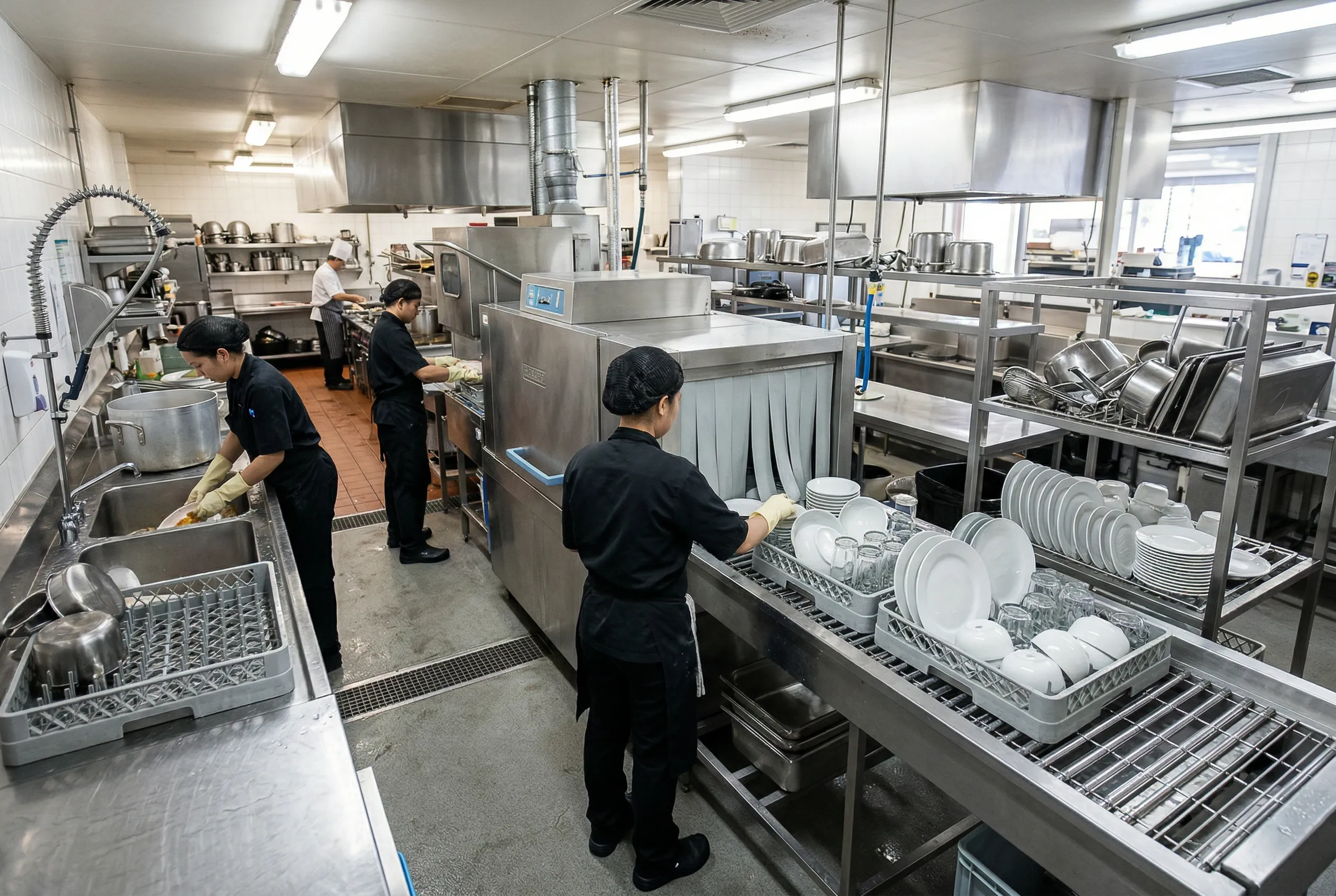
Conveyor dishwashers use a motorized belt to move racks through a series of wash zones automatically. One end takes dirty dishes; the other end delivers clean ones. They require more floor space (often 3 metres or more of linear run) and a larger utility hookup, but they process 200-400 racks per hour. These machines belong in high-volume environments: hotel restaurants, institutional kitchens, university cafeterias, and large catering operations doing 350+ covers daily.
Full comparison: specs that drive the decision
| Feature | Undercounter | Door-Type | Conveyor |
|---|---|---|---|
| Racks per hour | 20-30 | 40-175 | 200-400 |
| Covers per day (realistic) | Up to 150 | 150-350 | 350+ |
| Footprint | ~60 cm wide | 60-75 cm wide | 3+ m linear |
| Min. water inlet temp | 60 C (140 F) high-temp; 38 C (100 F) low-temp | 60 C (140 F) | 60 C (140 F) |
| Final rinse temp (high-temp) | 82 C (180 F) | 82 C (180 F) | 82 C (180 F) |
| Chemical sanitising option | Yes (low-temp models) | Yes (some models) | Yes (some models) |
| Water consumption per rack | 3-5 litres | 2-4 litres | 1.5-3 litres |
| Typical price range (CAD) | $2,500-$6,000 | $5,000-$18,000 | $20,000-$70,000+ |
| NSF certification required | NSF/ANSI 3 | NSF/ANSI 3 | NSF/ANSI 3 |
High-temp vs. low-temp sanitising: what’s the real difference?
This is where a lot of buyers get confused. Both methods meet Health Canada food safety standards when used correctly. The choice affects your operating costs more than it affects food safety outcomes.
High-temperature sanitising uses a final rinse at 82 C (180 F) to kill bacteria through heat. The advantages: no chemical cost for sanitiser, dishes air-dry faster because they come out hot, and the method is straightforward to verify. The disadvantages: you need a booster heater if your hot water supply doesn’t reach 60 C at the machine inlet, and the energy cost is higher.
Low-temperature sanitising uses chemical sanitiser (typically chlorine or iodine compounds) in the final rinse at a lower temperature. The advantages: lower energy consumption, no booster heater required, lower equipment cost. The disadvantages: ongoing chemical cost, dishes may need longer air-dry time, and chemical concentration needs regular testing to confirm efficacy. Chemical dispensing systems add complexity to the setup.
For most full-service restaurants in Canada, high-temp is the standard choice. Low-temp makes sense in locations where the water heating capacity is limited or where energy costs are a dominant concern. Bars that primarily wash glassware sometimes prefer low-temp because high heat can etch glass over time.
Installation requirements to sort out before you order
The dishwasher decision is connected to your kitchen’s utility infrastructure in ways that can catch you off guard if you don’t check in advance.
Hot water supply: high-temp machines need water inlet at minimum 60 C (140 F). Most commercial water heaters deliver this, but confirm. If you’re in a location with a shared or undersized water heater, you need either a booster heater or a low-temp unit.
Water pressure: most commercial dishwashers require 20-25 PSI at the inlet. Check your building’s supply pressure, especially in older buildings in cities like Montreal or Halifax where infrastructure varies.
Drain connection: confirm the drain type required by the unit (direct drain vs. standpipe) and that your kitchen floor drain can handle the discharge flow rate. Conveyor machines in particular discharge significant water volume during operation.
Electrical: undercounters typically run on 120V or 208/240V single phase. Door-type and conveyor machines usually require 208/240V three-phase. If your kitchen doesn’t have three-phase power, adding it is a real cost. Factor this into the total purchase budget.
Ventilation: all commercial dishwashers produce steam. A ventilation hood or exhaust fan above the dishwash area is standard practice and often required by code. Conveyor machines produce the most steam and typically require a dedicated exhaust setup.
FAQ: commercial dishwashers for Canadian restaurants
What dishwasher does a 100-seat restaurant need?
A 100-seat restaurant doing full table turns at lunch and dinner can easily reach 300-400 covers per day. For that volume, a door-type dishwasher in the 100-175 racks per hour range is usually appropriate. If you’re running a quick-service format with faster turns, size up. If you run one dinner seating only, a door-type at the lower end of the range works fine. Calculate your covers first, then add the 20% buffer.
Do I need NSF certification for my commercial dishwasher in Canada?
Yes. NSF/ANSI 3 certification is required by health authorities across Canadian provinces for commercial dishwashing equipment used in licensed food service operations. The certification confirms the unit sanitises effectively at its rated temperature and throughput. Most health inspectors will ask for the model number and check certification status, so don’t buy a unit that lacks it.
How long does a commercial dishwasher cycle take?
For undercounter and door-type units, the wash-rinse-sanitise cycle itself takes 60-120 seconds. Add loading and unloading time and you’re looking at 2-3 minutes per rack in practice. Conveyor machines run continuously, so throughput is measured in racks per hour rather than per cycle. Cycle time is one reason the racks-per-hour number is more useful for planning than cycle length alone.
What are the most reliable commercial dishwasher brands in Canada?
When looking for reliable commercial dishwashers in Canada, the best choice often depends on local service availability and your specific volume needs. Instead of focusing solely on specific brand names, look for manufacturers that have a strong track record, offer comprehensive warranties, and—most importantly—have authorized service technicians and readily available replacement parts in your area. Working with an experienced supplier like Canada Food Equipment guarantees you get a reliable unit backed by proper support.
Can I use regular dish soap in a commercial dishwasher?
No. Commercial dishwashers require specific detergents formulated to work at high temperatures and concentrations. Consumer dish soap produces excessive foam that can damage the pump and contaminate the wash water. Most commercial dishwasher suppliers recommend specific chemical brands and can set up automatic dispensing systems to ensure correct dosage every cycle.
Getting the dishwasher right is one of the easier decisions in a commercial kitchen once you know your volume. The main mistake is undersizing to save money and creating a bottleneck at the most visible point in your service. If you’re between types or unsure which model fits your kitchen layout, Canada Food Equipment in Etobicoke can help you match the right unit to your cover count, space, and utility setup. They stock commercial dishwashers for kitchens of every size.